HOTMUZ Spinal Decompression Devices

HOTMUZ builds two distinct traction devices for people managing herniated discs, sciatica, and chronic lumbar compression — a 3-pound wearable that generates 450N of mechanical force without electricity, and a full motorized decompression table with a high-torque linear motor that handles both lumbar and cervical therapy at the touch of a button. Both are built around the same core principle that makes clinical traction effective: horizontal axial decompression that removes gravitational load from the spine entirely. The manual device fits in a backpack and works anywhere; the motorized table handles users up to 300 lbs and eliminates the physical effort of manual cranking. Neither replaces professional care — but both make consistent daily traction possible without scheduling a clinic visit every time your back flares.

✓ 450N Mechanical Thrust✓ Independent Left/Right Adjustment✓ Manual or Motorized
See on Amazon
HOTMUZ Manual Lumbar Traction Device for Lower Back Pain Relief
450N of Force — Not Just Stretching

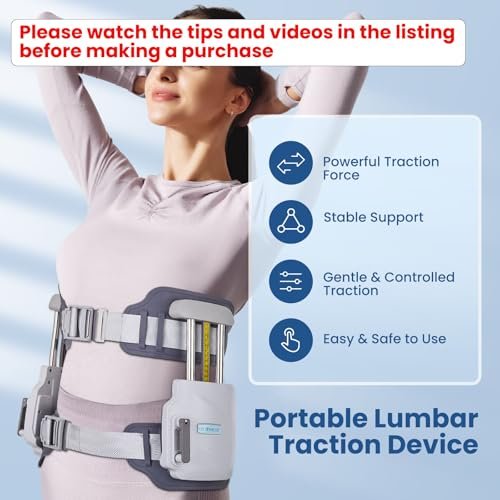
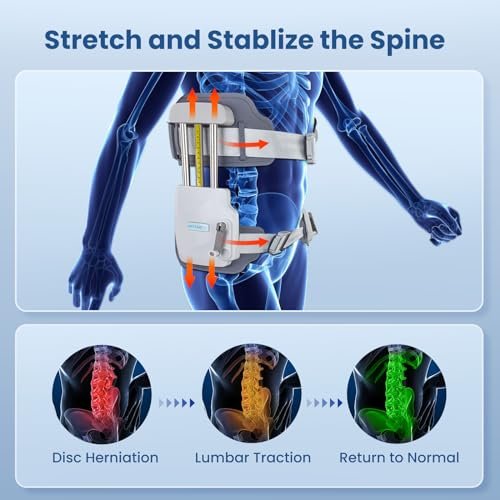
The rocker-driven screw system generates 450N of mechanical thrust — roughly 100 pounds of sustained pull — creating measurable intervertebral space, not soft-tissue compression.

Left and Right Sides Adjust Independently

Both HOTMUZ devices allow asymmetric force application — more pull on one side than the other — which matters for unilateral sciatica and mild scoliosis that equal bilateral traction can't address.

3-Pound Wearable or Motor-Driven Table

The manual unit weighs about 3 pounds and fits in a backpack; the motorized table delivers smooth, non-pulsating traction at a button press — two products built for two genuinely different situations.

Contraindications Published Upfront

HOTMUZ lists its disqualifying conditions directly — sequestrated herniations, osteoporosis, pregnancy, malignancy, spinal tuberculosis, and specific size limits — because brands honest about who shouldn't buy tend to be right about who should.

HOTMUZ Traction Devices for Home Use

The HOTMUZ lineup spans two distinct needs: a portable wearable for daily decompression on your schedule, and a motorized table for users who need effortless, full-body therapy without manual cranking. Choosing between them comes down to portability, body weight, whether cervical decompression is part of the picture, and how much physical effort you can comfortably put into a session.

HOTMUZ Manual Lumbar Traction Device for Lower Back Pain Relief

Manual Lumbar Traction Device

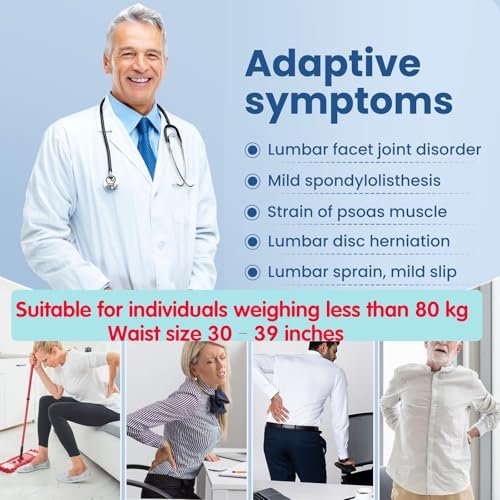
A rocker-driven mechanical device generating 450N of traction force through two independent screw channels — no electricity, no charging, weighing about 3 pounds. The scale panel on each side shows stretching distance in real time, and the left/right channels adjust separately for both bilateral and unilateral decompression. Fits waist circumferences under 39 inches; rated for users under 176 lbs.

The only wearable in the HOTMUZ line — backpack-portable and silent — making it the practical choice for anyone who needs consistent daily decompression at home, at the office, or traveling.

See on Amazon
Spinal Decompression Machine Decompression Table for Back Pain Relief

Motorized Spinal Decompression Table

A full motorized decompression table with a high-torque linear motor that delivers smooth, non-pulsating traction without manual effort. Covers both lumbar and cervical spine in a single unit, with adaptive airbags, 10 soft sponge rollers, and a 300-lb weight capacity — significantly higher than the manual device. Measures 47 × 6.7 × 17 inches and stores upright on built-in heavy-duty rollers. Comes with a 1-year manufacturer warranty.

The right choice for seniors, heavier users, anyone in acute pain who can't manage manual cranking, or anyone who needs cervical decompression alongside lumbar treatment — all in one machine.

See on Amazon

What the Research Actually Says

Spinal traction reduces short-term pain and disability — that's reasonably well-supported. A 2024 systematic review published in PMC found manual traction produced significant reductions in both pain intensity and functional disability compared to control groups. What the same literature is honest about: long-term structural changes are harder to demonstrate, and traction as a standalone intervention doesn't outperform sham traction in some Cochrane-affiliated analyses over extended follow-up periods.

HOTMUZ Manual Lumbar Traction Device for Lower Back Pain Relief

That tension — real short-term relief, mixed long-term evidence — is exactly what skeptical buyers encounter when they go digging.

Why the skepticism exists, and why it's partly justified

The NBC News coverage that surfaces in nearly every "spinal decompression" search captures the legitimate concern: patients have paid thousands of dollars for clinical decompression sessions with outcomes that don't always match the price. Reddit threads in r/backpain reflect this directly. One user flatly called decompression "a scam," citing a physician who told them no scientific evidence supported it. Another in the same thread described traction as "really good — it pulls your vertebra, easing the pressure from disc," and reported meaningful relief. Both experiences are real. They're not contradictory — they reflect the same mixed evidence base hitting different people with different conditions and different expectations.

The category's credibility problem isn't that the mechanism is fake. Reducing intradiscal pressure through axial traction is a physical reality — not a marketing claim. The problem is that some providers built a $6,000-per-course business on outcomes data that couldn't hold up at scale.

What changes when you bring the mechanics home

Here's the part that gets underreported: clinical traction research is largely based on once-or-twice-weekly sessions. The hypothesis behind home devices isn't that a single session cures a herniated disc — it's that consistent daily use compounds the short-term decompression benefit that the research already supports. A person who can decompress for 30 minutes three times a day, every day, accumulates more total traction time in two weeks than most clinical protocols deliver in a month.

That's the actual argument for HOTMUZ — not that it's clinically superior to professional equipment, but that frequency and consistency are themselves therapeutic variables, and home use makes both achievable.

How to read the evidence honestly

Short-term relief from lumbar traction is supported. Disc-compression-driven sciatica and herniated disc presentations at L4–L5 and L5–S1 are the conditions with the most documented response. Degenerative stenosis, sequestrated herniations, and structural instability respond differently — and in some cases shouldn't be treated with traction at all. The PMC 2024 review specifically examined manual traction for lumbar disc herniation; it is not a blanket endorsement of every decompression product for every spine condition.

HOTMUZ is a mechanical traction tool. It does what traction does — creates intervertebral space, reduces intradiscal pressure, takes load off compressed nerve roots — with a consistency that clinic visits can't match. It is not a structural cure, and anyone telling you otherwise is selling something the evidence can't support.

Who Should Not Use Traction Devices

Some spine conditions get worse with traction — not better. HOTMUZ publishes its contraindications directly in the product documentation, and they belong here, upfront, before anyone makes a purchase decision they'll regret.

Absolute contraindications for both devices

Stop reading the product pages and talk to your physician first if any of the following apply to you:

HOTMUZ Manual Lumbar Traction Device for Lower Back Pain Relief
  • Sequestrated or free-fragment disc herniation (CT-confirmed): If imaging shows disc material that has broken free from the nucleus and is floating in the spinal canal, traction can pull that fragment further into the nerve pathway. This is the single most important contraindication in this category. If your herniation diagnosis came from an MRI without CT confirmation of fragment status, ask your doctor before using any traction device.
  • Osteoporosis: Mechanical traction applies real force to vertebral structures. Compromised bone density means that force can cause fractures rather than decompression. This applies to both the manual device and the motorized table.
  • Malignancy affecting the spine: Tumors — primary or metastatic — change the structural integrity of vertebral tissue in ways that make traction dangerous. Any unexplained back pain that doesn't fit a mechanical pattern warrants imaging before any traction device is used.
  • Spinal tuberculosis: Active spinal TB creates destructive lesions in vertebral bodies. Traction is contraindicated.
  • Pregnancy: Neither device should be used during pregnancy.

Device-specific size and weight limits

The Manual Lumbar Traction Device has hard physical limits that affect its effectiveness — and safety — at certain body sizes.

  • Waist circumference over 39 inches (100 cm): The waistband and support pad geometry is optimized for waists under this threshold. Larger circumferences reduce the device's ability to transfer traction force cleanly to the lumbar spine.
  • Body weight over 176 lbs (80 kg): The 450N force output is calibrated for this weight range. Heavier users may find the traction effect insufficient, and the device is not rated for higher loads. The Motorized Spinal Decompression Table handles users up to 300 lbs (136 kg) and is the appropriate choice for larger individuals.

Conditions that require professional clearance first

These aren't automatic disqualifiers, but they require a conversation with a physician or physical therapist before starting:

  • Severe spinal stenosis with neurological deficit (numbness, weakness, or bowel/bladder changes)
  • Post-surgical spine — the timeline for safe return to traction varies significantly depending on the procedure
  • Hypermobility or ligamentous instability
  • Inflammatory arthropathies (ankylosing spondylitis, rheumatoid arthritis affecting the spine)

What to do if you're not sure

If you've had back pain long enough to be researching home traction devices, you've probably already seen a doctor. Go back with a specific question: "Is mechanical lumbar traction contraindicated for my diagnosis?" Most physicians can answer that directly. If yours can't, a physical therapist who works with spine patients will know immediately.

The Reddit threads where users describe decompression making their pain worse almost always involve one of two things: a contraindicated condition that wasn't identified, or too much force applied too early. Neither of those is an argument against traction as a category — but both are real risks that this section exists to prevent.

How to Use the Manual Device at Home

The Manual Lumbar Traction Device works best when it's applied precisely — and the setup details matter more than they look like they should. Done right, you'll feel a clear stretching sensation in the lumbar region within the first few minutes of a session. Done wrong, the force goes nowhere useful and the device shifts during use.

Before you start

Wear a thin, close-fitting garment under the device — a T-shirt or fitted undershirt. Thick clothing or silky fabrics reduce how cleanly the anti-slip pads grip your torso and interfere with force transfer. This is a detail that produces a surprising number of "it didn't seem to do anything" first sessions for people who skip it.

Placement and fit

  1. Position the lower support pad above your hip bones, not below them. The pad needs to sit at the iliac crest — the bony ridge of your pelvis — so the traction force travels upward through the lumbar spine rather than being absorbed by soft tissue below it.
  2. Tighten the waistband until it's snug but not restrictive. You should be able to take a full breath. The support pads must not slide when you move your hands away.
  3. Critical: do not attach both the upper and lower support pads to your clothing. The upper pad should rest against your body, not be pinned to your shirt. Attaching both pads to your garment creates a closed loop that cancels the traction — the device pulls your shirt instead of your spine.

Getting into position

Lie flat on a firm surface — a floor or a firm mattress, not a soft sofa cushion. This is the only position where the device delivers true axial traction. When you're horizontal, gravity is no longer compressing the lumbar spine, and the rocker mechanism can create intervertebral space instead of just counteracting gravitational load. Lying flat is not a comfort recommendation — it's a mechanical requirement for the therapy to work the way clinical traction works.

HOTMUZ Manual Lumbar Traction Device for Lower Back Pain Relief

Applying traction force

Work the rocker in slow, deliberate movements. You're looking for a clear sensation of stretch and support in the lower back — not a sharp pull, not a cracking feeling, just sustained elongation. Start with modest force on your first few sessions, especially if you haven't used a traction device before.

The scale panel on each side shows your stretching distance in real time. For the first week, stay conservative — a few millimeters of visible separation on the scale is enough. The 4.7-inch maximum push rod stroke is the absolute ceiling, not a target for day one.

Unilateral vs. bilateral adjustment

If your pain is predominantly one-sided — say, left-leg sciatica from left-side nerve compression — you can increase traction on the left channel while keeping the right at baseline. Turn the left screw incrementally more than the right and check how the stretch sensation distributes. Equal turns on both sides applies bilateral traction for general lumbar decompression. This is the asymmetric adjustment that inversion tables can't replicate, and it's worth experimenting with once you're comfortable with the baseline setup.

Session length and frequency

Thirty minutes per session, two to three times daily, is the protocol the device is designed around. Don't compress three sessions into one long stretch — the cumulative daily frequency is the point. Most users begin to notice consistent effects after 15 days of regular use. Early sessions may produce mild muscle soreness in the lumbar region; this is a normal adaptation response. If you experience sharp, radiating, or worsening nerve pain during a session, stop immediately and consult your physician before continuing.

Which HOTMUZ Device Fits Your Situation

Two products, meaningfully different use cases. The right choice depends on your body, your living situation, and what your back actually needs — not on which one looks more impressive.

Start here — four questions that decide it quickly

1. Do you weigh more than 176 lbs (80 kg)?
If yes: the Manual Lumbar Traction Device is not rated for your weight. The motorized table handles users up to 300 lbs (136 kg) and is the only HOTMUZ option that covers higher body weights with full traction effectiveness.

2. Does your pain include your neck — not just your lower back?
If yes: the manual device is lumbar-only. The Motorized Spinal Decompression Table covers both lumbar and cervical spine. If you're managing both a herniated lumbar disc and chronic neck stiffness or cervical disc compression, the motorized table is the only device that addresses both in a single setup.

3. Can you comfortably crank a manual mechanism, or is any physical effort during a session a problem?
The manual device requires working the rocker to generate and maintain traction force. For most users this is straightforward. But if you're in acute pain, have limited hand or wrist strength, or are managing a condition where any physical effort during therapy is uncomfortable, the motorized table delivers steady, non-pulsating traction at a button press — no cranking, no inconsistent force application.

4. Do you need to use the device in multiple locations — office, travel, home?
The manual device weighs about 3 pounds and fits in a backpack. The motorized table is 47 inches long and stored upright in a corner. Portability is a real differentiator here — if your routine requires the device to move with you, the manual unit is the only practical option.

If you're still deciding

The manual device is the right starting point for most adults under 176 lbs who need consistent daily lumbar decompression and want the flexibility to use it anywhere. It's more involved to set up correctly than the motorized table, and the early learning curve is real — but once you know the placement protocol, sessions take minutes and go wherever you go.

The motorized table is the right choice if you're a heavier user, need cervical coverage, prefer effortless operation, or want the closest home equivalent to what a clinic actually uses. It requires a dedicated space, doesn't travel, and costs more — but the 4.0/5 rating across 41 reviews is the stronger of the two product ratings, and the consistent motor-driven traction eliminates the user-error variable that trips up some manual device users.

One honest note: don't choose the motorized table just because it feels more substantial or more "medical." If you're under 176 lbs, dealing only with lumbar issues, and willing to follow the placement protocol, the manual device generates 450N of real mechanical traction — that's approximately 100 pounds of pull — which is a serious therapeutic force in a device you can carry in a bag.

HOTMUZ for Seniors and Limited Mobility

The Motorized Spinal Decompression Table was built with a specific user in mind: someone who needs real, consistent spinal decompression but can't — or shouldn't — spend effort making it happen. Seniors managing chronic lumbar compression, post-surgical recovery patients, and anyone whose back pain is severe enough to make physical effort during therapy counterproductive all fit that description.

Why manual cranking is the wrong ask for many users

The manual device's rocker mechanism is straightforward for most adults. But generating and holding traction through a hand-crank system requires grip strength, a degree of wrist and arm stability, and the ability to sustain focus on force application while lying flat. For a 68-year-old managing arthritis alongside a lumbar disc herniation, that's three compounding physical demands on top of the therapy itself. The motorized table removes all three: press a button, the linear motor applies smooth, non-pulsating traction at the precise force level you set, and holds it.

That's not a minor convenience feature. It's the difference between a device someone will use consistently every day and one they'll stop using after two weeks because every session is its own physical effort.

The inversion table comparison matters here

Inversion tables are a legitimate spinal decompression option for some users — but they become significantly less appropriate as users age or develop cardiovascular concerns. Inverting fully or partially raises intracranial pressure and increases strain on the eyes and blood vessels. For users with hypertension, glaucoma, or a history of stroke, full inversion carries documented risk. The motorized HOTMUZ table decompresses the spine in a flat, horizontal position — gravity isn't being reversed, just removed from the lumbar equation. There's no head-down position, no ankle-joint loading, no cardiovascular demand.

Practical features that make a difference

  • 300 lb (136 kg) weight capacity: Significantly higher than the manual device's 176 lb limit, which matters because the senior and limited-mobility population skews toward users who may not fit smaller devices.
  • Adaptive airbags: Support the spine's natural lumbar and cervical curvature during traction — helpful for users whose musculature doesn't maintain neutral alignment on its own.
  • 10 soft sponge rollers: Minimize friction during extension, so the traction movement is genuinely comfortable rather than creating surface pressure against the back.
  • U-shaped footrest: More stable and comfortable than a horizontal bar, which matters for users who have difficulty with ankle or foot positioning.
  • Built-in heavy-duty rollers: After a session, the table can be moved to a corner and stored upright. For users with limited strength, not having to lift or carry the device to store it is a real practical benefit.
  • 1-year manufacturer warranty: The motorized table is the only HOTMUZ device with a documented warranty — relevant for buyers who are making a larger investment and want coverage.

A realistic expectation

The motorized table won't replicate a DRX9000 clinical session — that machine costs more than most cars and operates under direct supervision with real-time disc pressure monitoring. What it does is apply consistent, motor-driven lumbar and cervical traction in a comfortable, safe position, without demanding anything physical from the user beyond lying down and pressing a button. For someone who has been making the drive to a PT clinic once a week, that's a meaningful shift in what daily decompression actually looks like.

See the HOTMUZ Device Working in Real Time

We embedded this walkthrough because it shows you exactly what using the manual traction device looks like outside of product photos — on a real person, in a real home setup. You'll see how the wearable fits, how the rocker-driven mechanism applies force, and what the experience of lying-flat traction actually looks like in practice. If you're on the fence about whether this feels mechanical enough to make a difference, this is the video that answers that question.

How Do the Two HOTMUZ Devices Compare

HOTMUZ makes two fundamentally different products — a portable manual traction device and a full motorized decompression table. The specs below show what separates them across the decisions that actually matter: how much force each delivers, who fits, what conditions each addresses, and how much physical effort you'll need to put in.

Feature Manual Lumbar Traction Device Motorized Spinal Decompression Table
Drive Type Manual (rocker-driven screw) Electric (high-torque linear motor)
Traction Site Lumbar spine only Lumbar + cervical spine (2-in-1)
Force Output 450N (approx. 100 lbs of sustained pull) Motor-driven precision; adjustable intensity
Weight Limit 176 lbs (80 kg) 300 lbs (136 kg)
Waist / Size Fit Under 39 inches (100 cm) waist Adjustable shoulder and leg supports
Portability ~3 lbs; fits in a backpack 47 × 6.7 × 17 in; stores upright on built-in rollers
Recommended Position Lying flat (seated and upright also possible) Lying flat (supine)
Warranty Not specified 1-year manufacturer warranty

If you're under 176 lbs, need something you can use at your desk or take traveling, and your issue is lumbar-only, the Manual Lumbar Traction Device is the practical daily-use choice. If you're over that weight limit, need cervical coverage alongside lumbar work, or want button-press operation without any manual cranking, the Motorized Spinal Decompression Table is the right call — it also has the headroom for heavier users that the manual device simply doesn't offer.

What HOTMUZ Buyers Say After Real Daily Use

"I've been sitting at a desk for 11 years and started getting that deep L4 ache that never fully goes away. The manual device took a few sessions to dial in — getting the pad placement right matters more than I expected — but once I did, there's a real pulling sensation that a foam roller just doesn't produce. I use it lying flat on the floor every morning. The scale panels on each side are a nice touch; I can actually see I'm getting traction, not just compression."
— Marcus T., Software Engineer, remote work setup
"After my L5–S1 herniation I did six weeks of PT and then lost access when my plan ran out. I was skeptical a home device could replicate what the traction table at the clinic did, but honestly the horizontal position here gets closer than I expected. It's not identical, but 30 minutes lying flat three times a day is more cumulative traction time than I was getting with one PT visit a week. The device shifts a little on my mattress — firmer surface works much better."
— Christine M., managing L5–S1 herniation post-PT
"My sciatica runs down my left leg and nothing bilateral was touching it. The independent left/right adjustment on this thing is the reason I bought it over the cheaper belts. I set the left side about 30% higher than the right and it's noticeably different. Not a cure — the pain comes back if I skip sessions — but for managing flare-ups without reaching for ibuprofen, it's become a real part of my routine."
— David R., dealing with recurring left-side sciatica
"I bought the motorized table after trying a manual traction device from another brand and finding the cranking too painful during acute flare-ups. The button-press operation on this one means I can use it even on bad days. Setup takes a few minutes to learn but the instructions are clear. The cervical headgear works reasonably well for neck stiffness too, which I wasn't expecting to care about. Four stars because the footrest is a little awkward to position if you're on the shorter side."
— Patricia W., 64, using it post-spinal procedure for maintenance
"Rated it four stars because the effects are real but temporary — you need to use it consistently. I'm a project manager, sitting 9-plus hours a day, and this has cut down how often I need to book a chiropractor visit. The portability is genuinely useful; I brought it on a work trip and used it in the hotel room. Weighs less than my laptop bag. If you go in expecting a maintenance tool rather than a one-time fix, it delivers."
— Renee A., operations manager, frequent traveler
"I researched inversion tables before landing here. The inversion angle bothered my blood pressure and my ankles couldn't take the load. The motorized table is a completely different experience — lying flat, no head-down pressure, and the airbag support actually conforms to my lumbar curve. The 300-pound weight rating gave me confidence the frame would hold. It's not a small piece of equipment but the upright storage footprint is smaller than I expected."
— Glen S., 58, avoiding surgery for lumbar stenosis

Common Questions About HOTMUZ Traction Devices

Does a spinal decompression machine really work?

Spinal decompression devices generate real, measurable traction force that reduces intradiscal pressure and can create intervertebral space. A 2024 systematic review published in PMC found manual traction significantly reduces short-term pain and disability in lumbar disc herniation patients. Long-term structural evidence is mixed — HOTMUZ is best understood as a consistent maintenance and adjunct tool, not a permanent cure.

What are the side effects of a lumbar traction machine?

The most common side effects are temporary muscle soreness after early sessions and, if force is applied too aggressively, muscle spasms. These typically resolve on their own. HOTMUZ recommends starting at a low stretching intensity and building gradually. Severe or sharp discomfort is a signal to stop and consult a doctor — mild adaptation soreness is normal during the first week or two of use.

Is traction good for an L5–S1 disc bulge?

Disc-compression-driven herniation at L5–S1 is one of the primary use cases for lumbar traction devices like the HOTMUZ Manual Lumbar Traction Device. The horizontal traction reduces intradiscal pressure, which can allow bulging disc material to retract and relieve nerve root compression. It is not appropriate for sequestrated or free-fragment herniations — a CT confirming disc type is important before starting.

How many times a week should you do spinal decompression?

HOTMUZ's recommended protocol for the Manual Lumbar Traction Device is 30 minutes per session, two to three times daily. Most users begin noticing meaningful effects after approximately 15 days of consistent use. The motorized table's session length follows similar guidance — frequent, shorter sessions compound benefit more effectively than infrequent long ones.

Is spinal decompression better than lumbar traction?

"Spinal decompression" and "lumbar traction" describe overlapping mechanisms. The HOTMUZ Motorized Spinal Decompression Table functions closer to computerized decompression — it delivers adjustable, non-pulsating motor-controlled force with adaptive airbag support for spinal curvature. The Manual Lumbar Traction Device is a mechanical traction tool. Both reduce intradiscal pressure; the motorized unit offers more precision and bilateral lumbar plus cervical coverage.

How can I decompress L4 and L5 at home?

The HOTMUZ Manual Lumbar Traction Device used in the lying-flat position is one of the most accessible at-home options for L4–L5 decompression. Lying flat removes axial load from the lumbar spine entirely — the same principle behind horizontal traction in professional settings. Position the lower support pad above the hip bones, tighten the waistband on a thin garment, and rock the lever slowly until you feel a stretching sensation without sharp pain.

What is the best lumbar traction device for home use?

"Best" depends on the user's weight, condition, and how they'll actually use it. The HOTMUZ Manual Lumbar Traction Device suits adults under 176 lbs who need a portable, daily-use lumbar tool with independent bilateral and unilateral adjustment. The HOTMUZ Motorized Spinal Decompression Table fits heavier users, those who need cervical coverage, seniors, and anyone whose pain makes manual cranking impractical.

Is there a downside to spinal decompression?

Yes — a few honest ones. Long-term structural evidence is limited; most research supports short-term pain and disability reduction rather than permanent disc repair. The HOTMUZ manual device has firm size and weight limits (waist under 39 inches, under 176 lbs) that exclude a meaningful portion of users. Some people experience increased soreness during the first week of use. And like most physical therapies, consistency matters — skipping sessions reduces cumulative benefit.

Are all spinal decompression machines the same?

No. There are two main mechanical approaches: cable-and-pulley traction systems that apply uniform pull, and split-table decompression units where upper and lower body portions move independently to isolate specific disc levels. HOTMUZ's motorized table uses a linear motor with adaptive airbags; the manual device uses a rocker-driven screw system. These differ meaningfully from simple inflation belts, inversion tables, and clinical machines like the DRX9000.

Does the HOTMUZ device work for sciatica?

The HOTMUZ Manual Lumbar Traction Device's independent left/right adjustment is specifically useful for unilateral sciatica — where nerve compression is predominantly on one side. Setting the affected side to a higher traction force than the other applies asymmetric decompression that a standard bilateral device can't replicate. This does not apply to sciatica caused by sequestrated disc fragments, which is a contraindicated condition for traction.

Who should not use a HOTMUZ traction device?

HOTMUZ explicitly lists these contraindications: CT-confirmed sequestrated or free-fragment disc herniation, osteoporosis, pregnancy, malignancy affecting the spine, and spinal tuberculosis. The Manual Lumbar Traction Device adds physical size limits — waist circumference over 39 inches or body weight over 176 lbs. Anyone in those categories should consult a physician before attempting any home traction therapy.

Why HOTMUZ Builds Home Traction Devices

The core problem HOTMUZ was built around isn't complicated: traction therapy works partly because of frequency, and most patients can't get it frequently enough. A once-weekly clinical appointment — when you can get one, when insurance covers it, when you can take the time — doesn't compound the way daily sessions do. Patients who benefit from horizontal axial traction in a clinic setting often see that benefit erode by the time they return, because six days of sitting, standing, and loading the lumbar spine undoes what one session started. HOTMUZ exists to close that gap.

The product line reflects two distinct versions of the same problem. The Manual Lumbar Traction Device — weighing about 3 pounds, fitting in a backpack, requiring no electricity — is for the person who needs consistent daily decompression and wants to use it at home, at the office, or while traveling. The Motorized Spinal Decompression Table is for the person who needs more: heavier frame, cervical coverage, button-press precision that doesn't demand anything from a back that's already in pain. HOTMUZ is manufactured by Changsha Jinghai E-commercial Co., Ltd. and sold through Amazon, which is also where warranty support and product inquiries are handled.

The brand doesn't claim to replace professional care. Both devices are positioned as adjunct tools — the kind of thing that makes the space between clinical visits more productive rather than pretending those visits aren't necessary. That's a narrower claim than most competitors in this space make, and it's a more honest one. Home traction produces measurable force, measurable intervertebral space, and — for the right user with the right condition — real, repeatable relief. That's what HOTMUZ is designed to deliver.

Useful Guides

Clinical evidence supports consistent at-home traction for managing herniated discs and sciatica—here's how to use it safely.

About HOTMUZ

HOTMUZ is manufactured by Changsha Jinghai E-commercial Co., Ltd. and sells its lumbar traction and spinal decompression devices through Amazon. The brand's product line currently includes two devices — a portable manual traction device and a motorized decompression table — both designed for at-home use as adjuncts to professional spinal care.

Customer Support

Product inquiries, questions about fit or usage, and after-purchase support are handled through the official HOTMUZ Amazon storefront. You can find the storefront at amazon.com and search for HOTMUZ, or access it directly through the product listings linked on this site. Amazon's messaging system is the verified contact channel for this brand.

Warranty and Availability

The Motorized Spinal Decompression Table carries a 1-year manufacturer warranty, as documented in the product listing. Warranty terms for the Manual Lumbar Traction Device are not specified in available product documentation — check the current Amazon listing for up-to-date details. Both products ship and are fulfilled through Amazon.